

SILENT FABRIC — PERCEPTION, THRESHOLDS, AND BEHAVIORAL SPACE (13 Nov 2025, Paris)
Updated: Aug 8
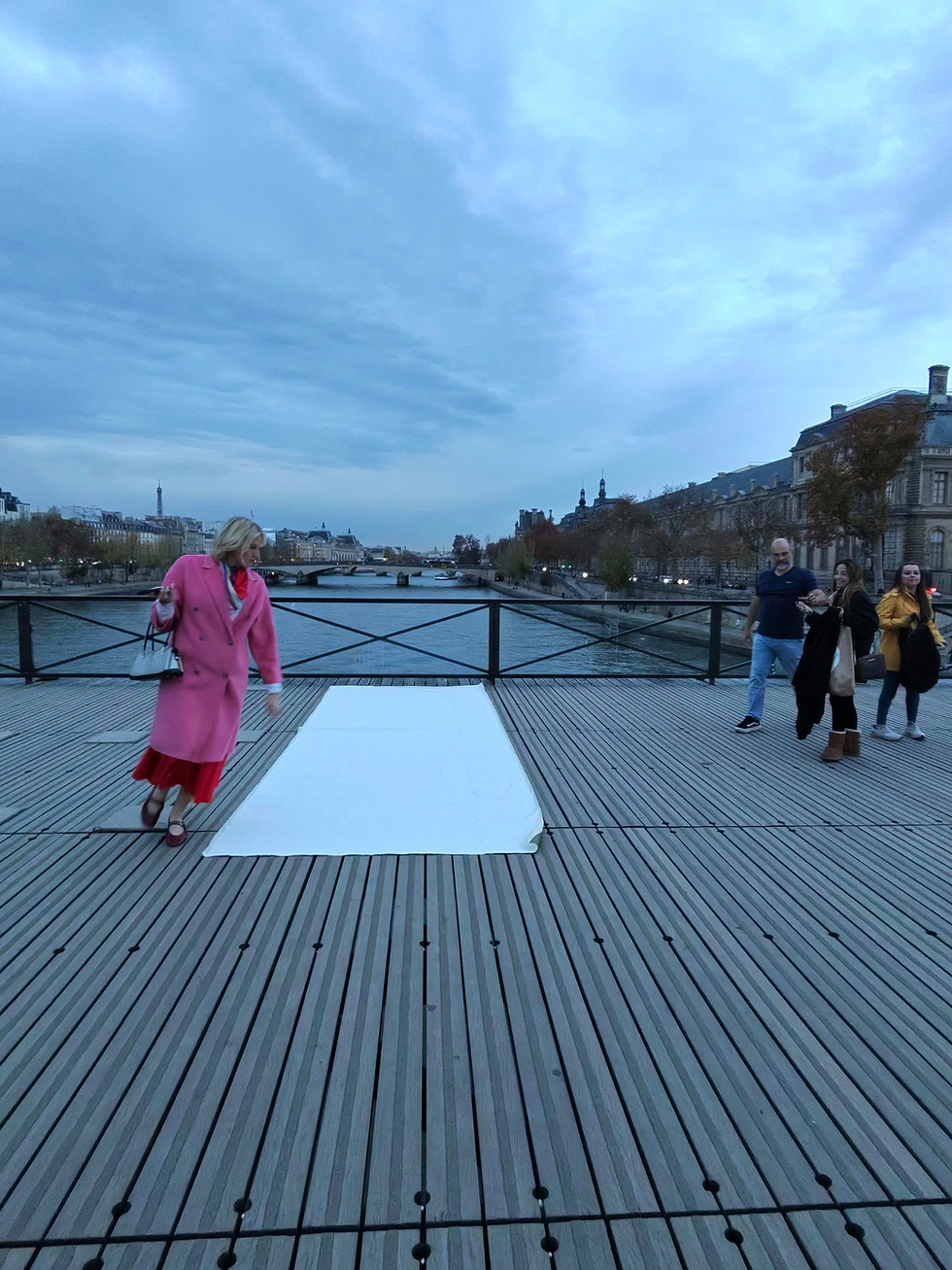
Silent Fabric is an experimental site-specific installation that investigates how perception shapes bodily behavior within public space through the presence of a textile surface. The work examines how human movement can be subtly guided without physical barriers, explicit instructions, or visible signs—solely through material presence.
During the installation process, no directional cues, written instructions, symbols, or physical obstacles were used. Nevertheless, when encountering the textile surface, most individuals instinctively avoided stepping onto it. They altered their paths, hesitated, or repositioned their bodies in response to the fabric. These reflexive reactions formed one of the most significant layers of the work. The responses did not arise from conscious decision-making, but rather from deeply internalized perceptual codes that operate at a bodily level.
This led to a central question within the work: Can a surface, without issuing any explicit warning, guide behavior simply through its presence?
Silent Fabric does not physically divide space; instead, it redefines it perceptually. Rather than creating rigid or permanent boundaries, the installation produces a soft yet effective threshold. This threshold is invisible, but its impact is tangible. The fabric is not perceived as an obstacle, yet it reorganizes movement and spatial negotiation. Through this perceptual shift, space is behaviorally transformed without being materially altered.
The conceptual foundation of the work is rooted not in abstract theory, but in lived experience. Prolonged observation of how perception operates in everyday life—how it silently directs actions and is often accepted without questioning—formed the basis of this experiment. In Silent Fabric, perception is treated not as a purely visual phenomenon, but as an embodied force that shapes decisions and movements beneath conscious awareness.
For the artist, the installation functioned as a field of observation rather than control. Audience reactions were not predetermined, and this unpredictability was an essential component of the work. The moments of hesitation, detour, or distancing constituted the work’s living process. Silent Fabric does not intervene; it observes, reveals, and makes visible.
The choice of textile as a medium is deliberate. Fabric is not an architectural element; it is temporary, lightweight, and unstable. Precisely because of this fragility, it establishes a more sensitive and bodily relationship with space. The capacity of such a soft material to generate significant behavioral change highlights how perception operates independently of solidity or force.
Silent Fabric approaches the relationship between textile and space not merely on a visual or formal level, but on a behavioral and embodied plane. The work exposes how space is read, negotiated, and internalized—often without conscious reflection. Individuals rarely question whether they are being guided, as questioning itself requires a specific degree of awareness and freedom.
In this sense, Silent Fabric functions as a silent trigger. A surface, a pause, and a decision. At times, the most profound internal shifts emerge through the simplest experiences. The work opens an inquiry into the mechanisms of perception—not as an overt manipulation, but as a subtle, pervasive force shaping both individual and collective behavior.
This text was written as part of an ongoing artistic research process and has been shared in connection with an academic thesis project. The work continues to evolve across different contexts and formats.

Comments